Con la tecnología de Blogger.

3/18/2016

Unknown

EnPro Agrees to $480 Million Settlement of Garlock Asbestos Claims March 18, 2016


EnPro Industries Inc. said it has agreed to a $480 million settlement to resolve current and future personal injury claims related to its asbestos-lined gaskets used in pipes, valves and other industrial applications.
The settlement was between EnPro, its now bankrupt unit Garlock Sealing Technologies, Garlock’s direct parent Coltec Industries Inc. and court-appointed representative for current and future asbestos claimants.
A word from our sponsor:
Sponsored by: Smart Choice. Click here for more info.Need top-rated markets for your agency? Smart Choice can help! We offer access to quality markets with no start-up or monthly fees, discounted E&O, and the chance to earn bonus and contingency shares. Plus you'll retain 100% ownership of your book of business!
Click here to contact us today!
EnPro said it would set up and fully fund a $480 million trust, estimating that the after-tax value of its contribution would to be $284 million. EnPro has also committed to set aside up to about $17 million to resolve Canadian cases.
EnPro said the trust would assume responsibility for all present and future asbestos claims related to Garlock or Coltec, thereby covering all EnPro businesses ever to have received asbestos claims in the United States.
Garlock filed for bankruptcy in 2010 due to the mounting costs of lawsuits. Bankruptcy-related lawsuits unsealed in late January allege that lawyers, to drive up settlements, hid evidence that their clients were exposed to products made by other companies that were bankrupt at the time.
EnPro said on Friday that the settlement was yet to be approved by the claimants, the bankruptcy court and the U.S. district court.
The company also proposed a plan, which is to be approved by the claimants, to restructure Coltec and shift its assets and units into a new subsidiary that will be responsible for all claims and certain insurance.
The new subsidiary will then file for pre-packaged Chapter 11 bankruptcy petition, which EnPro expects will be administered with Garlock’s Chapter 11 case, in late 2016 or early 2017.
Read More
Unknown

USD/CAD Retail Sentiment in Focus Ahead of Canada Budget


- USD/CAD Retail Sentiment Hits Fresh Near-Term Extremes Ahead of Canada Budget.
USDOLLAR Outlook Remains Mired by Waning Bets for Fed Rate-Hikes; August Low in Focus.
Avoid the pitfalls of trading by steering clear of classic mistakes. Review these principles in the "Traits of Successful Traders" series.

USD/CAD
USD/CAD Daily Chart
Chart - Created Using FXCM Marketscope 2.0
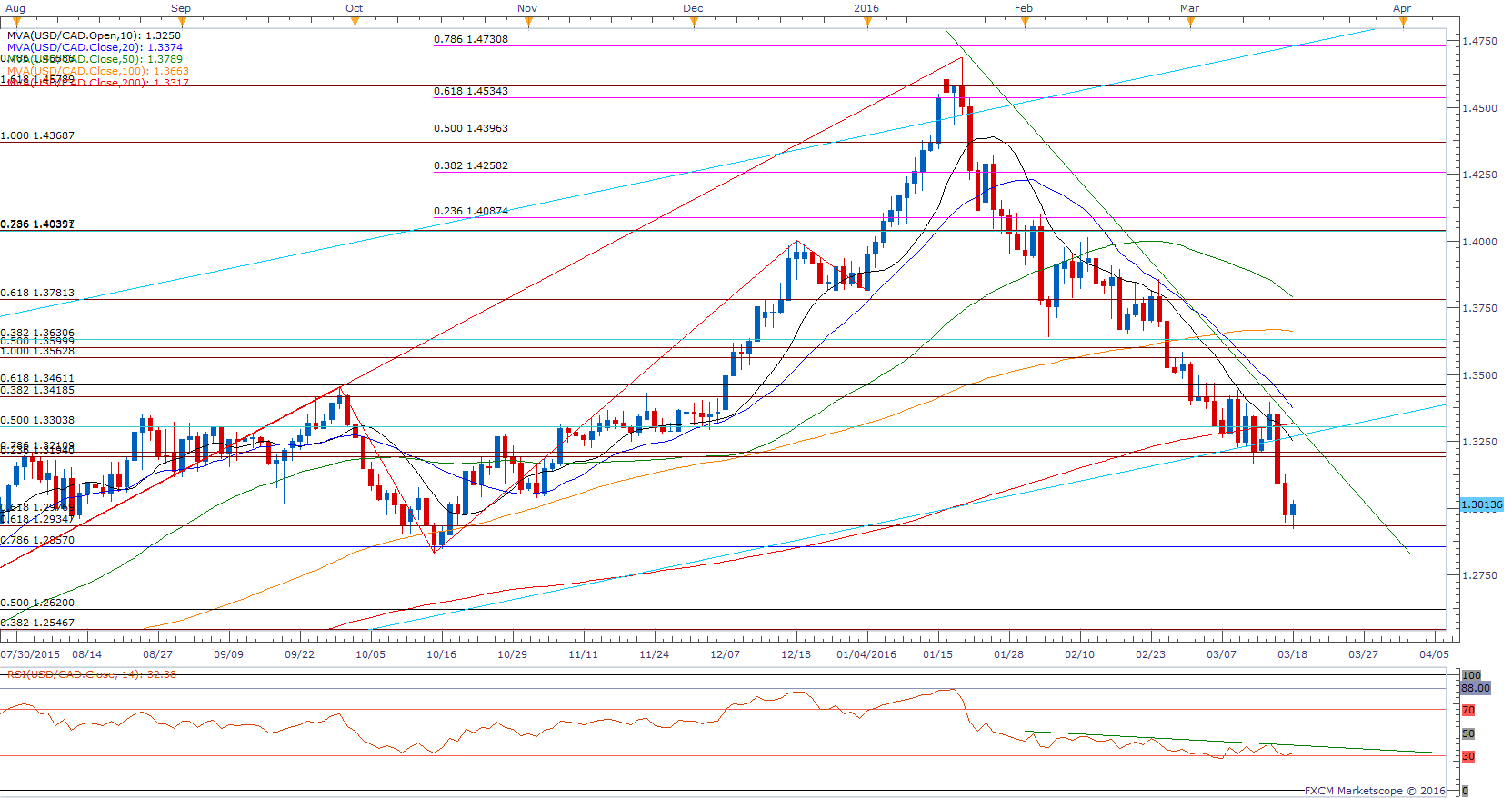
  • Despite the softer-than-expected inflation report out of Canada, USD/CAD stands at risk for a further decline in the days ahead amid the recent series of lower highs & lows, while price & the Relative Strength Index (RSI) retain the bearish formations from earlier this year.
  • With Canada’s budget statement due out on March 22, a meaningful fiscal stimulus package may heighten the appeal of the loonie as it takes pressure off of the Bank of Canada (BoC) to further support the real economy; may see a material shift in the monetary policy outlook should Governor Stephen Poloz show a greater willingness to move away from the easing cycle.
  • Will keep a close eye on the downside targets as USD/CAD continues to search for support, with the next key area of interest coming in around 1.2860 (78.6% retracement) to 1.2831 (October low).
USD/CAD SSI
  • The DailyFX Speculative Sentiment Index (SSI) shows the retail FX crowd remains net-long USD/CAD since February 25 even as the pair slips to a fresh 2016 low, with the ratio hitting fresh near-term extremes as it makes it way towards the +2.00 region.
  • The ratio currently stands at +1.85 as 65% of traders remain long ahead of the weekend, with long positions 7.4% higher from the previous week, while short positions have slipped 10.8% during the same period.
Why and how do we use the SSI in trading? View our video and download the free indicator here
Join DailyFX on Demand for Real-Time SSI Updates Across the Majors!
USDOLLAR(Ticker: USDollar):
Index
Last
High
Low
Daily Change (%)
Daily Range (% of ATR)
DJ-FXCM Dollar Index
11888.28
11898.44
11846.83
0.16
80.01%
USD/CAD Retail Sentiment in Focus Ahead of Canada BudgetUSDOLLAR Daily Chart
Chart - Created Using FXCM Marketscope 2.0
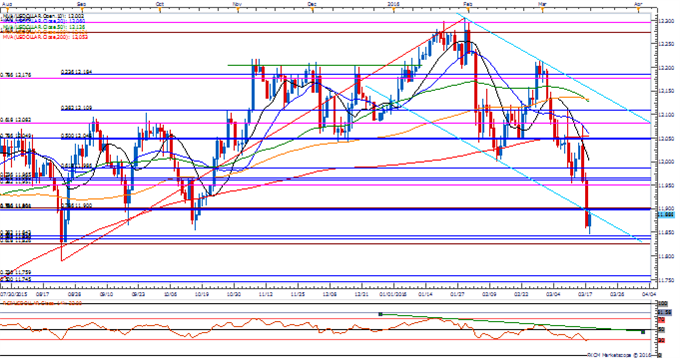
  • USDOLLAR remains vulnerable to further losses as market participants scale back bets for Fed rate-hikes in 2016, but the greenback may face a larger rebound over the near-term as the RSI appears to be turning around ahead of oversold territory.
  • The mixed data prints coming out of the U.S. economy may continue to dampen the appeal of the greenback as the unexpected decline in the U. of Michigan Confidence survey undermines Fed expectations for a ‘consumer-led’ recovery this year; will keep a close eye on the U.S. Durable Goods Orders report on tap for the week ahead as demand for large-ticket items are anticipated to contract 2.8% in February.
  • The break/close below 11,900 (78.6% retracement) raises the risk for a move back towards 11,789 (August low), and we may see former support around 11,951 (38.2% expansion) to 11,965 (23.6% retracement) act as new resistance amid the longer-term bearish formations in price & RSI.
USD/CAD Retail Sentiment in Focus Ahead of Canada Budget

Read More

2/19/2016

Unknown

Trading the “Flying Buddha” Pattern Part 2


In the first part of this series I explained the “Flying Buddha” candlestick pattern which can be used to trade Forex profitably. In this second part I will explain methods you can use to enhance the profitability of this entry method. I will also compare back test results with results of another similar entry strategy and we will see whether there is anything special about trading the “Flying Buddha” pattern.

Testing the “Flying Buddha” Pattern

Let’s start by taking a look at back test results. A back test was conducted from 2002 until the end of 2015, which is a total of 16 years covering many types of market conditions. The currency pairs examined were the seven major USD currency pairs. Hypothetical trades were taken following “Flying Buddha” candlesticks on the H4 London time chart only if the price was above its levels from 3 months and 6 months ago (for long trades), or below its levels from 3 months and 6 months ago (for short trades). Entries were placed 1 pip past the “Flying Buddha” candlestick, with stop losses placed just the other side of the candlestick, or if the previous candlestick extended beyond that, then just the other side of that previous candlestick.
When trading the “Flying Buddha” pattern, the entry candlestick was the final candlestick of the trading week, it was not taken and was excluded from the results. If a trade entry was not triggered during the very next candlestick following the “Flying Buddha” candlestick, then the trade was cancelled.
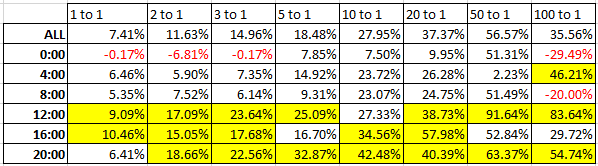
During the period covered by the back test there were 5,307 hypothetical trades. The hypothetical results are shown in the table below, in total and by currency pair, in the form of expectancy per trade at different reward to risk profit targets.
FB 1
It is easy to see that the method had a positive expectancy that increases with the size of the profit target all the way up to a reward to risk ratio of 100 to 1!

Comparison of “Flying Buddha” Pattern Results with Rough Entry Results

Let’s compare those results with the result of a back test covering the same currency pairs and time period, but using a different entry method: just using the next candle break of any candlestick that made a low beyond the previous four candlesticks in an upwards trend, or vice versa in a downwards trend. There were 6,482 hypothetical trades, i.e. about 20% more trades than there were in the “Flying Buddha” test. The results of this back test are shown below:
FB 2
If we compare the headline results of all of the hypothetical trades taken trading the “Flying Buddha” pattern, we see that this entry method was a little superior to the less discriminating entry method, but there is not really a great deal in between the two methods. This is good news, as it shows you have two different entry methods that can be used to profitably exploit trends!

“Flying Buddha” Pattern by Time of Day

Now let's break these results down further. Is there a great difference between the “Flying Buddha” entries that appeared at different times of the day? The times shown in the table below are London times:
FB 3
It is clear that the three best times to enter a trade are during the four hour periods that begin at midnight London time (which is also midnight UTC, or very close to it), and then later at noon and 4pm (which correspond to the first two-thirds of the New York business hours, including the London/New York overlap).
Before we try to draw any conclusions in trading the “Flying Buddha” pattern from this, let’s take a look at the back test results from the other entry method, also broken down by time periods:
FB 4
We can see that noon and 4pm look like good times to enter trades here too. However midnight looks much worse and 8pm much better. This might be due to an effect caused by a very strong move taking place just before the New York close, which would be likely to produce a “Flying Buddha” candlestick ending at midnight London time. This effect might be producing a fast reversion to the mean.

Candlestick Range

Another filter that could be useful when trading the “Flying Buddha” pattern is time of day by currency pair. The tip here is first to avoid trading the USD/CAD pair between midnight and 8am. This really stands out as the biggest variance by time of all the currency pairs tested here. It makes sense as the Asian session is well outside the business hours of the U.S.A. or Canada.
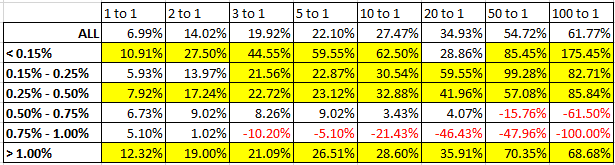
One final filter to consider is the size of the “Flying Buddha” candlestick itself, or more specifically, the range between the trade entry level and its stop loss. After all, as the profit targets are defined by reward to risk, a smaller candle that gives 200 pips maximum profit could be more profitable than a larger candle that gives 300 pips profit as using a constant risk per trade would produce different position sizes. Let’s look at profitability by the ranges of the entries for the “Flying Buddha” trades:
FB 5
Looking at the stats, there's no question that the smaller candlesticks or two-candlestick combinations do produce more profitable results than the overall average where the range is less than 0.50% of the price of the currency pair. However, notice how the really huge candlesticks that represent more than 1% also tend to produce superior results, because such huge fast movements that have already snapped back towards the moving averages are likely to continue in that direction.

Conclusion

There is plenty of tried and tested material here in this article to build a complete, long-term trend trading strategy. Exact entry strategies are not so very important, what is more important instead is sticking to a plan for entry and taking every opportunity that comes along because in trend trading, it is important not to miss the big winners, even when the set-up does not seem to be of particularly high quality.
Remember that in Forex, it is quite possible to not get any long, strong moves for quite a while, so it is important to take profits here and there, regularly, because if you sit tight waiting for the huge 1,000 pip winners, they may not come for a year or so.
Read More
Unknown

Understanding the Major Forex Global Currencies


Far too many Forex traders make the mistake of not thinking about what they are trading beyond price fluctuations on a screen. While it is true in trading that price is king and also that prices are never too high to go higher or too low to go lower, you will trade better over time if you have some understanding of what makes the currencies you are trading unique. Understanding the major Forex global currencies will make you a better, a more focused, and more profitable trader.

Which are the Major Forex Global Currencies?

There are eight currencies that are most important in the Forex universe. They are as follows, more or less in the consensus order of importance:
USD (U.S. Dollar)
EUR (Euro)
JPY (Japanese Yen)
GBP (British Pound)
CAD (Canadian Dollar)
CHF (Swiss Franc)
AUD (Australian Dollar)
NZD (New Zealand Dollar)
Additionally, the Chinese Yuan (CNY) is becoming increasingly important, although it is not yet fully convertible. There is an “onshore” Yuan and an “offshore” Yuan, the latter of which is offered for trading by many Forex brokers.
The ranking shown above was not simply ordered by relative GDP or any other economic indicator. Instead, the layering of importance given to the various currencies takes into account convertibility, use as a global reserve, and correlation with important commodities. For example, there are several countries, such as India, which have much larger economies than Switzerland or Australia. However, Australia is an important producer of gold and several other commodities which are used in manufacturing, while Switzerland’s banks hold a huge proportion of global private capital and especially gold, giving both of these currencies weights beyond the national economies which they represent. You must think beyond simple economics to succeed in understanding the major Forex global currencies.

Currencies are National Debt

All modern currencies are paper backed by nothing more than the promise of the central bank of the nation to honor the obligation. Currencies are 100% debt.

USD is King

The first thing any Forex trader should be mindful of in understanding the major Forex global currencies is that the USD is of primary importance. All of the other currencies are judged first of all in their worth against the USD. Therefore you can trade Forex much more simply by focusing on the seven other currencies paired with the USD instead of worrying about every possible permutation, although there are a few exceptions.
The importance of the USD is due not only to the huge size of the U.S. economy, which is larger than that of any other nation, and almost as large as the entire Eurozone. It is due also to the U.S.A.’s unique position as the architect of the global financial system and the world’s only superpower. The U.S. dollar is the major reserve currency of the world, and there is greater cash wealth held in U.S. dollars than in any other currency.
This means that the USD is usually going to be the major driver of currency movements. If people around the world want to hold USD, it will go up and tend to push most other currencies down, and vice versa. Over the past 15 years, the USD has trended more predictably and strongly than any other major global Forex currency, which is something that helps in understanding the major global Forex currencies.

“Safety” vs. “Risk” Currencies

For various reasons, the market tends to see the following currencies as safe havens, so they tend to increase in relative value when there is market turmoil caused by fear over global economic prospects: USD, JPY, and EUR. The CHF used to be the ultimate safety currency, but is seen as less so due to some wild revaluations triggered by the Swiss National Bank, and also due to its very high negative interest rate of -0.75%.
The other currencies tend to perform well when there are good prospects for global economic growth. An appreciation of risk on against risk off sentiment is a big help in understanding the major global Forex currencies.

Commodity Currencies

Certain currencies are very highly positively correlated with the prices of various commodities, as these countries are large producers of the commodities in question. Major examples are the CAD, which is positively correlated with the price of Crude Oil, and the AUD, which is positively correlated with the price of Gold. The NZD tends to do well when there is rising demand for dairy products and lamb.

Liquidity

Most traders will notice that different currency pairs have different “personalities”: some are very volatile and move quickly (a good example is GBP/JPY), while others tend to only move by going two steps forward, one step back (the perfect example being EUR/USD). This is because of the liquidities of the respective currencies. There are more Euros and U.S. dollars than any other currencies and this is why their prices tend to move quite slowly. However, when you look at currencies such as the GBP, JPY and CHF, there are much smaller amounts involved, and when they either strongly in or out of demand, a liquidity squeeze can result in the price moving very fast.

Time of Day

Generally, currency rates move the most during London and New York business hours, but also during their home business hours. This means for example that the GBP tends to be quite flat during the early part of the Tokyo session, but that there will tend to be less activity in the Australian and New Zealand dollars except during the earlier London and later New York sessions, which overlap to some extent with the “home” business hours. This is partly due to the fact that currency rates are often moved by economic data releases and central bank statements that of course are scheduled during home business hours.
While the factors covered within this article are not going to be the first or only things that traders are going to be thinking about, keeping this information in mind can help traders to be more flexible and successful when trading particular currencies.
Read More

2/12/2016

Unknown

Regulation in Forex Markets-Why and How?


The Foreign Exchange (FX) market is the largest, most liquid market in the world – with around US $5.3 billion traded daily. Day trading is quite common among currency traders but most investors depend on setting up trading accounts and executing their trades via Forex brokers.
There are hundreds of Forex brokers and new ones are constantly opening their doors to the public. This makes it difficult for traders to choose the best brokerage and leaves them at the mercy of the broker when it comes to honesty and transparency. Despite its huge size, regulation in the Forex market is scarce and there is no single global body to police it 24/7.
There are no accurate statistics, but the number of Forex and binary options brokers that work under a regulatory authority is minimal (5 percent is usually cited) and that leaves many firms able to take advantage of their clients and to engage in abusive behavior without any consequences.

Non-Regulation Risk

For retail FX traders, the biggest downside to the lack of Forex regulation for most brokers is that of illegal activity or outright fraud as well as runaway losses in a market increasingly dominated by speculative activity and large institutions.
Following a spate of currency-related swindles during the period between 2001 and 2008, the CFTC created a special task force to deal with the problem and stiff Forex regulations were introduced several years later to protect retail FX traders.
Under the Commodity Exchange Act (CEA), the CFTC assumed jurisdiction over leveraged Forex transactions offered to retail clients in the United States. The Act permits only regulated entities to act as counterparties for Forex transactions with retail customers in the States and it requires that all online Forex dealers be registered and meet the strict financial standards enforced by the National Futures Association (NFA).
On the institutional level, banks, which are responsible for 95 percent of daily FX trading, are heavily regulated. The U.S. Federal Reserve and the U.S. Treasury Department are highly attentive to regulation in the Forex industry and monitor brokers carefully for evidence of manipulation.

Forex Regulation-Why?

Why is regulation in Forex so important? The objective of regulation is to ensure fair and ethical business behavior. Under current regulatory contracts, all foreign exchange brokers, investment banks and signal sellers are required to operate in strict compliance with the rules and standards laid down by the Forex regulators or their activities can be deemed unlawful. These bodies must be registered and licensed in the country where their operations are based, which ensures quality control standards are met. they are Brokerage houses are subject to periodic audits, reviews and evaluations which force them to maintain the industry standards. In addition, regulated Forex brokers must keep a sufficient amount of funds to be able to execute and complete foreign exchange contracts concluded by their clients and also to return clients’ funds intact in case of bankruptcy.
Should a regulatory agency find a broker infringing on its guidelines, it can use a wide range of enforcement powers – criminal, civil and regulatory – to protect consumers and to take action against firms or individuals that do not meet acceptable standards.
It can publish notices that are important to ensure the transparency of decision made by the authority and inform the public thereby maximizing the deterrent effect of enforcement action.
Some regulators issue alerts about financial services firms and individuals, based both overseas and in their local areas.
Of course, there can be no assurances that any action taken by a regulatory agency such as the FCA in the UK will result in a payment or return of funds or securities even where formal disciplinary actions are taken and sanctions imposed.
Many of the actions taken by regulatory agencies against the brokers covered under their authorities can also be applied to non-regulated brokers that find themselves in similar situations by police and other enforcement agencies but their mandate is limited and is less likely to be imposed leaving investors with reduced recourse in the event fraudulent behavior.
Forex regulators operate within their own jurisdictions but often work together in pursuit of duplicitous activities. In fact, in the European Union a license from one member state covers the whole continent.
Over the years regulators around the globe have tried to organize some sort of universal regulatory umbrella. MiFID (Markets in Financial Instruments Directive) was introduced in the UK in 2007 and has been the cornerstone of Europe’s financial regulatory regime since then.
The MiFID regulation is now being revised to improve the functioning of financial markets in light of the financial crisis and to strengthen investor protection. The changes are currently set to take effect from January 3rd, 2017, although discussions are taking place between the European Commission, European Parliament and the Council of the European Union about the possibility of implementation being delayed. The new legislation is known as MiFID II and includes a revised MiFID and a new Markets in Financial Instruments Regulation (MiFIR).
There are, however, powerful voices working to lobby against the wholesale Forex market coming under a wide regulatory cover. The Association for Financial Markets in Europe (‘AFME’), an industry body, has come out against the MIFID II strict regulations and has published a paper recently stressing that “unintended consequences” could result in over-regulation of the Forex industry which would prevent brokers from serving their traders comfortably.

Local Approaches

At the moment, there is no uniform approach globally when it comes to this market. The regulatory industry continues to act on a local level with each broker applying for regulation in a chosen location and some organizations are more active than others. In Japan, one of the world's most active retail Forex market, the Financial Services Authority (FSA) regulates all markets including retail foreign exchange. The FSA is proactive in regulating retail Forex trading and has reduced the maximum leverage that can be made available to retail Forex traders several times in the last few years. In the United Kingdom where the FCA (formerly the FSA) is the main regulatory agency and in most of continental Europe, regulation is in scant amount and as mentioned above, there are few limits on the amount of leverage offered.
CySEC, the financial regulatory agency of Cyprus, is part of the European MiFID regulations but it has attracted a number of overseas firms who wish to take advantage of what is seen as light regulations and an easy way to get a license without having to meet the stringent requirements that are imposed by other European financial regulators.
Presently, relative non-regulation of the institutional Forex market continues to pose ongoing risks to the retail investor which includes higher currency volatility and discrepancies in available public information.
Despite the difficulty and expense for brokers to function under an authorized regulatory body, there are many worthy brokers that choose to do so and these should be considered above all others. Traders have a wide selection of regulated brokers in their own jurisdiction or in other regions as well and they will find all the same features—and more—with regulated brokers as with non-regulated ones.
Read More